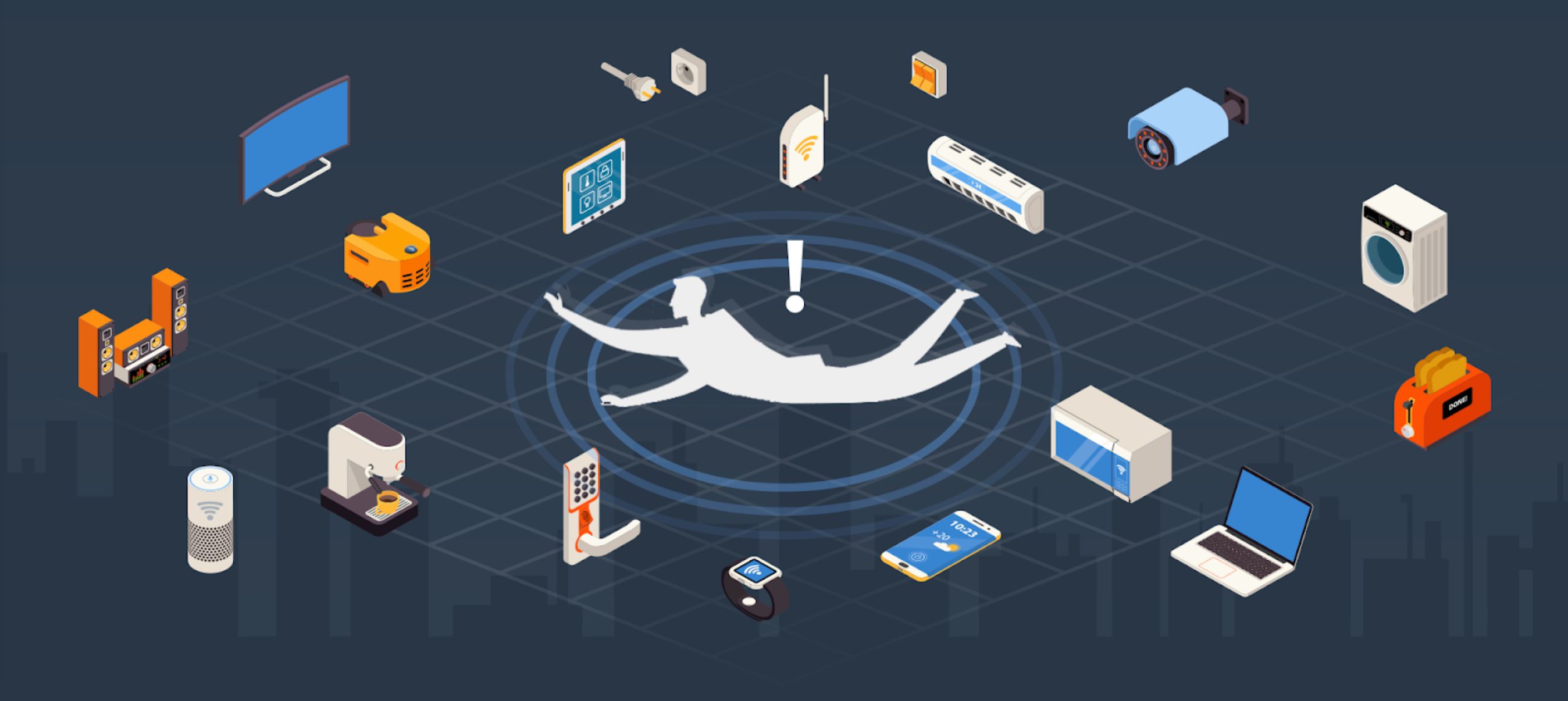
Big Tech Is Acquiring Access to Your Health & Home

SMART HOMES: THE FINAL FRONTIER

It’s no secret that tech giants have long collected, analyzed, and sold users’ data for profit – a strategy now commonly referred to as “surveillance capitalism”. As detailed by privacy pioneer, Dr. Shoshana Zuboff, the origins of this phenomenon date back to Google in 2001, where, in an effort to boost profits and survive the dotcom bust, Google began running simulations on private data to predict user behavior and maximize click-through rates.
This was wildly profitable for Google, driving a 3,590% increase in revenue from 2001-2004 and culminating in a $1 (0h 4m).9 billion IPO in 2004. Surveillance capitalism was officially born.
Almost two decades later, unmasking private user data, manipulating user behavior, and profiting at the expense of user privacy is the lifeblood of many corporations. As the world becomes more digital, the amount of data that surveillance capitalists jam into their algorithms is skyrocketing, enabling corporations to know us better than we know ourselves.
According to the EFF, Google controls 62% of mobile browsers, 69% of desktop browsers, and 92% of internet searches worldwide. Google also knows who you email (Gmail), where you go (Maps), what you watch (YouTube), and much more.
All data across all products is then compiled into a new, highly profitable product: “digital profiles” of users, just like you.
Tech giants are now expanding into new industries to supplement these digital profiles with real world data. Information from our at-home lives is a honey pot for surveillance capitalists, who know: if a picture is worth a thousand words, then a recorded conversation is worth a thousand keystrokes.
Smart speakers and security cameras are now the eyes and ears of our smart homes, and Big Tech is watching.

BILLION DOLLAR DATA ACQUISITIONS

Over the past decade, Amazon, Apple, Facebook, Google, and Microsoft made over 500 acquisitions worth trillions of dollars. Although it is common for corporations to acquire companies for new users, four recent acquisitions by Amazon and Google illuminate a new strategy to acquire companies for new data.
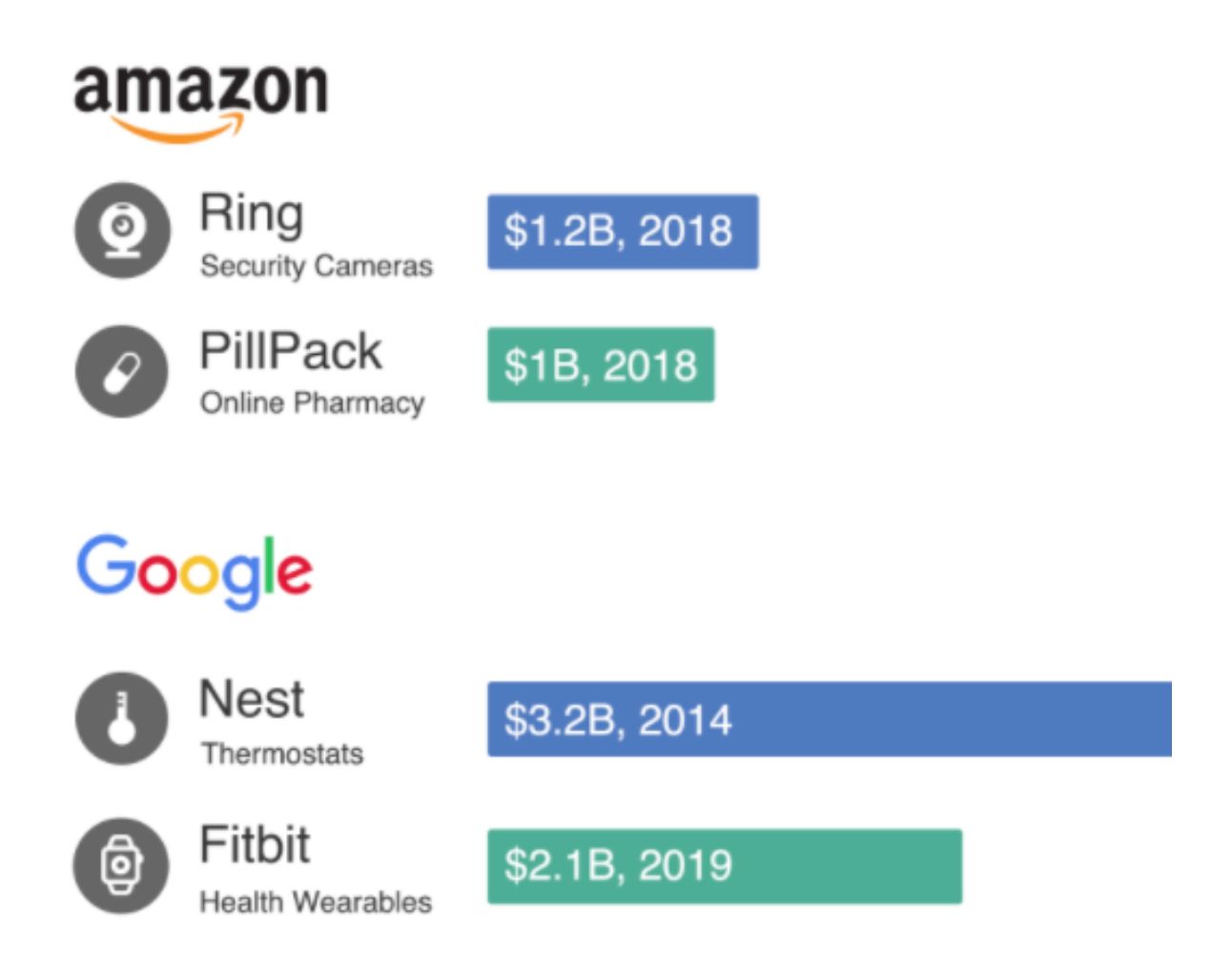
In the past two years, Google bought FitBit for $2 (0h 8m).1B along with the health data of its 28 million users, while Amazon spent $1 (0h 4m)B to acquire PillPack, an online pharmacy with medical information of millions of users.
With access to this new trove of health data, including fitness activity, heart rate, and prescriptions, Amazon and Google are taking an inside look into our bodies.
This data acquisition strategy also involves our homes, as evidenced by Amazon and Google’s purchase of Ring and Nest for $1 (0h 4m).2B and $3 (0h 12m).2B, respectively.
Ring and Nest began as camera and thermostat makers, but have now expanded to locks, motion sensors, smoke alarms, and more. Behind the façade of these acquired smart home brands, Amazon and Google have effectively entered the living rooms of millions of people worldwide.
How they will use our health and home data is a black box, but one thing is for sure: it will not remain private. After all, privacy is the single largest existential threat to surveillance capitalists.

PATENT PENDING: SIGNALING THE FUTURE

To complement their new acquisitions, Amazon and Google are also investing heavily in patents. While patents offer insight into a company’s mindset, they are not always indicative of a company’s future plans. In the case of Amazon, let’s hope that is true.
In 2018, Amazon patented a new feature for its virtual assistant Alexa, which is built-in to their vast line of at-home smart speakers and on-the-go wearables.
The patent suggests Alexa will be able to auto-detect your emotions based on your speech patterns and use this information to suggest things to do, watch, or purchase.
The patent shares an example scenario where a woman is sniffling while speaking; after deciphering the user is ill, Alexa suggests a chicken soup recipe for her cold and offers to order cough drops on Amazon. This is not based on what the user said, but how she said it – Alexa really knows you.
What Amazon really wants is not just access to your data, but control of your home.
Several other patents, such as automatic environment sensing and policy enforcement, show Amazon’s desire to control our data, devices, and ultimately our homes.
But this is just the tip of the iceberg; in 2019, Amazon submitted a patent for an “unmanned aerial vehicle (UAV) that performs surveillance at a property defined by a geofence”. In other words, Amazon’s very own surveillance-as-a-service, which would extend their reach further into our neighborhoods.
We cannot wait until these issues are sufficiently understood by lawmakers to protect our privacy. As history has shown, the capitalistic tendencies of Big Tech will only grow – as they creep slowly into our homes and neighborhoods, we must push back and take control of our data and privacy before it is too late.

About IoTeX

Founded as an open source platform in 2017, IoTeX is building the Internet of Trusted Things, an open ecosystem where all “things” — humans, machines, businesses, and DApps — can interact with trust and privacy. Backed by a global team of 30+ top research scientists and engineers, IoTeX combines blockchain, secure hardware, and confidential computing to enable next-gen IoT devices, networks, and economies. IoTeX will empower the future decentralized economy by “connecting the physical world, block by block”.


Learn more: Website | Twitter | Telegram | Medium | Reddit


Testadex Group News: The FCC authorizes Amazon’s satellite internet net...

Testadex Group News: The FCC authorizes Amazon’s satellite internet net...: KEY POINTS The FCC declared on Thursday that Amazon may build its ambitious satellite internet system, which would compete with SpaceX’s Sta...

The FCC authorizes Amazon’s satellite internet network that would compete with Elon Musk’s Starlink

KEY POINTS
  • The FCC declared on Thursday that Amazon may build its ambitious satellite internet system, which would compete with SpaceX’s Starlink network.
  • Amazon’s project, known as Kuiper, would see the company launch 3,236 satellites into low Earth orbit.
  • Morgan Stanley has declared that Kuiper has the potential to be a ”$100 billion opportunity” for Jeff Bezos’ company.
  • Jeff Bezos, founder and chief executive officer of Amazon, speaks in Washington, D.C., on Sept. 19, 2019.
  • Jeff Bezos, founder and chief executive officer of Amazon, speaks in Washington, D.C., on Sept. 19, 2019.
    Andrew Harrer | Bloomberg | Getty Images
  • The Federal Communications Commission declared on Thursday that Amazon may build its ambitious satellite internet system, which would compete with SpaceX’s Starlink network.

    Amazon’s project, known as Kuiper, would see the company launch 3,236 satellites into low Earth orbit. Amazon says it will deploy the satellites in five phases, with broadband service beginning once it has 578 satellites in orbit.

    “We conclude that grant of Kuiper’s application would advance the public interest by authorizing a system designed to increase the availability of high-speed broadband service to consumers, government, and businesses,” the FCC secretary Marlene Dortch said in its authorization order.

    The company has not outlined a timeline or cost for Kuiper and the FCC said the company has not finished the satellites’ design. But Morgan Stanley has declared the high-speed internet network has the potential to be a ”$100 billion opportunity” for Jeff Bezos’ company.

    Kuiper is poised to go toe-to-toe with SpaceX’s Starlink network of high-speed internet satellites, which Elon Musk’s company has been steadily launching for the past year. SpaceX has launched more than 500 Starlink satellites and aims to begin offering direct-to-consumer broadband service later this year.

  • https://www.cnbc.com/video/2019/12/19/amazon-and-elon-musks-spacex-plan-to-launch-more-satellites-than-ever.html

  • One issue that SpaceX pushed back on during was Kuiper’s approach to orbital debris. While Amazon emphasized that it would remove its satellites from orbit within 355 days of them completing their missions, SpaceX pointed out that Kuiper “failed to submit a casualty risk analysis” of whether Amazon’s satellite debris might survive reentry. Part of that analysis would be an estimate calculating “the probability of human casualty,” which the FCC said Amazon will have to latter present as a part of a final debris mitigation plan.

    Notably, SpaceX wasn’t the only one to push back during the FCC’s consideration of Amazon’s application. Iridium Communications, Hughes Network Systems, Intelsat, Inmarsat, SES, WorldVu, Telesat and Theia also filed comments about or petitions against Kuiper’s application. 

    Amazon’s space reach

    Amazon has steadily expanded its reach in the space industry, most recently setting up a new unit called Aerospace and Satellite Solutions under its Amazon Web Services division.

  • Jeff Bezos, founder of Amazon, Blue Origin and owner of The Washington Post via Getty Images, introduces their newly developed lunar lander "Blue Moon" and gives an update on Blue Origin and the progress and vision of going to space to benefit Earth at the Walter E. Washington Convention Center.

  • Jeff Bezos, founder of Amazon, Blue Origin and owner of The Washington Post via Getty Images, introduces their newly developed lunar lander “Blue Moon” and gives an update on Blue Origin and the progress and vision of going to space to benefit Earth at the Walter E. Washington Convention Center.
    Jonathan Newton | The Washington Post | Getty Images
  • While wholly separate from Amazon, Bezos also runs another space venture called Blue Origin that is developing next-generation rockets and spacecraft such as a lunar lander for returning humans to the moon. A team led by Blue Origin recently won a NASA contract worth $579 million as it competes with Elon Musk’s SpaceX and aerospace contractor Dynetics to build spacecraft that help the agency achieve its goal of landing astronauts on the moon by 2024.

    Kuiper is the name of a belt of objects that include asteroids and dwarf planets. It was named for the late Dutch American astronomer Gerard Kuiper.

Industrial Internet Consortium Publishes Distributed Ledgers in IIoT White Paper

The Industrial Internet Consortium® (IIC™) today announced the publication of the Distributed Ledgers in IIoT White Paper. The white paper is an overview of the use of distributed ledger technologies (DLTs) in IoT and was written to help IIoT decision makers incorporate them in their environments. The white paper includes use cases, architectures and building blocks necessary for scalable industrial deployment.

A distributed ledger is a consensus of replicated, shared and synchronized data spread across multiple sites, countries or institutions. “DLTs are relevant to industrial IoT because they provide a safe, immutable distributed ledger that stores sensor data and allows information to be verified without relying on a third-party authority,” said Michael McBride, Sr. Director of Innovation & Technology Strategy, Futurewei and Co-chair of the IIC Distributed Ledger Task Group. “This reduces mistakes and fraud, particularly along the IIoT supply chain. Industrial companies are using DLTs successfully for everything from shipping-container tracking to vehicle identity and history to energy trading to farm-to-store tracking.”

Types of distributed ledger technologies include:

  • Blockchain - a historical record of transactions, much like a database, that can contain financial and non-financial transactions distributed across several systems in near-real-time over a peer-to-peer network
  • Directed acyclic graphs - directed acyclic graphs nodes that send transaction events to nodes that are participating in a transaction
  • Smart contract – a computer program that directly controls the transfer information between parties under certain conditions. The contract is stored on the distributed ledger and triggers a specific smart contract when a transaction occurs

While DLTs have great potential for disrupting and improving industry, ensuring scalability for industrial applications can be challenging. Several technologies are available to address scalability challenges, including:

  • Hardware-layer solutions - high-end machines used to accelerate blockchain operations
  • Data-layer solutions that boost transaction performance by increasing block size and reducing the intervals at which blocks are created
  • Network-layer solutions that optimize network bandwidth usage and increase connectivity among blockchain nodes to improve the transaction throughput
  • Consensus-layer solutions that enable greater scalability
  • Off-chain solutions that off-load transactions from the main blockchain to reduce network traffic

“Distributed ledgers are a nascent technology but they are already being used in IoT environments,” said Xinxin Fan, Founding Member and Head of Cryptography, IoTeX, and Co-chair of the IIC Distributed Ledger Task Group. “If companies use due diligence in testing, DLTs can be used for a competitive advantage.”
Use cases in select vertical industries described in the white paper include:

  • Mediledger Network – pharmaceuticals
  • Alibaba Food Traceability – transportation
  • Amazon Managed Blockchain and Quantum Ledger Database - infrastructure
  • Walmart Farm-to-Store - transportation
  • Dun & Bradstreet Business Identity – finance & banking    
  • Everledger Diamonds – mining & minerals
  • Wien Energie – energy & utilities
  • SkyCell Smart Containers – transportation & logistics
  • Maersk’s & IBM’s Global Trade Platform - transportation
  • Bosch & TÜV Odometer – transportation
  • Deloitte Supply Chain with Integrated IoT and ERP - automotive

The authors of the Distributed Ledgers in IIoT White Paper include: Michael McBride, Futurewei; Pieter van Schalkwyk, XMPro; Bassam Zarkout, IGnPower; Lei Zhang, iExec; Xinxin Fan, IoTeX, Alex Ferraro, PwC, and Anoop Nannra, Trusted IoT Alliance and Co-chair of the IIC Distributed Ledger Task Group. The white paper can be found on the IIC website here.

About Industrial Internet Consortium
The Industrial Internet Consortium is the world’s leading organization transforming business and society by accelerating the Industrial Internet of Things (IIoT). The IIC delivers a trustworthy IIoT in which the world’s systems and devices are securely connected and controlled to deliver transformational outcomes. The Industrial Internet Consortium is a program of the Object Management Group (OMG). For more information visit http://www.iiconsortium.org.

Note to editors: Industrial Internet Consortium is a registered trademark of OMG. For a listing of all OMG trademarks, visit https://www.omg.org/legal/tm_list.htm. All other trademarks are the property of their respective owners.

Source: https://www.prweb.com/releases/industrial_internet_consortium_publishes_distributed_ledgers_in_iiot_white_paper/prweb17283410.htm

Testadex Group News: A Value Comparison of Two Interesting IoT-Centric ...

Testadex Group News: A Value Comparison of Two Interesting IoT-Centric ...: IoTeX and IOTA are two cryptocurrencies that are looking to connect IoT and cryptocurrency to improve efficiency and security. All data is a...

A Value Comparison of Two Interesting IoT-Centric Cryptocurrencies: IoTeX vs IOTA

IoTeX and IOTA are two cryptocurrencies that are looking to connect IoT and cryptocurrency to improve efficiency and security.

All data is as of 2:47 CST on 7/25/20IOTAIoTeX
Started19 December 201514 February 2018
Marketcap$758,797,699 (50586513h 16m)$40,388,725 (2692581h 40m)
Max Supply2,779,530,28310,000,000,000
Total Supply2,779,530,2839,734,304,443
Circulating Supply2,779,530,2835,134,304,442
Price$0.27 (0h 2m)3020$0.00 (0h 0m)786684
ConsensusTangleRoll-DPoS
Centralized or DecentralizedCentralizedDecentralized
Tx Confirmationsvia Centralized Coordinator Servervia 36 Consensus Delegates
FinalityWithin seconds (centralized coordinator)Instant
FeesFeeless (so they say)Extremely Low Fees (1% of a penny)
PartnershipsMany partnershipsHas partnerships, but not as many as IOTA
ProductsI was unable to locate an actual product powered by IOTA– Ucam is on the market now & rivals any other security camera available buy at ucam.iotex.io

– Pebble Tracker is under development & will soon be released
Industry Standing– MOBI

– Linux Foundation

– Chamber of Digital Commerce

-FIWARE

– data .austintexas.gov

– Austin City UP

– INATBA
– Co-chairs of the Industrial Internet Consortium (IIC)

– Advanced Corporate Members of the IEEE Standards Organization

– Confidential Computing Consortium (CCC)

– Solid collaborations with Nordic Semiconductor and Tenvis

This isn’t an all-inclusive list of every comparison. I just wanted to highlight some of the key points to show how undervalued IoTeX really is. If you’re a new entrant into cryptocurrency with an interest in IoT, it’s pretty much a no-brainer which crypto asset has the most value for your $$$. We also can’t overlook how centralized IOTA is in its current state. We keep hearing that this is temporary, but IOTA has been building for several years and they are still centralized.

IoTeX offers a fully decentralized blockchain with unbelievable transfer speed and finality. They’ve recently onboarded 5 new projects to build on IoTeX. The projects represent the following areas: Healthcare IoT, big data, e-commerce, analytics, and gaming. These projects are joining as part of IoTeX’s Halo grant program: https://iotex.io/halo

Here is a brief description of the projects:

  • HealthBlocks: proactive and private healthcare service that allows users to own, analyze, and manage their health data
  • Helix: integration of IoTeX blockchain data to BigQuery, Google’s open-source data platform, for advanced analytics
  • Metanyx: integration of IoTeX with WooCommerce for IOTX and XRC20 payments on over 3 million E-commerce sites
  • Smart Stake: detailed analytics dashboards for IoTeX stakeholders for Delegate performance, rewards, and more
  • GameFantasy: integration of IOTX & VITA to web-based gaming ecosystems to fuel decentralized currency/points

In addition to this, IoteX’s groundbreaking Ucam will be available on Amazon very soon, which will ensure even more adoption. It can currently be purchased on ucam.iotex.io

The future is very bright for IoTeX. Not to take anything away from IOTA, but IoTeX is miles ahead in terms of delivering on what they set out to do. And this is even with IOTA having a head start by multiple years. IoTeX’s value speaks for itself. check out their website, follow their social media, and you will see the hardest working team in crypto deliver day after day.

Source: https://themoorethoughts.com/crypto/a-value-comparison-of-two-interesting-iot-centric-cryptocurrencies-iotex-vs-iota/

EU Privacy Shield Ruling Is an Opportunity and Conundrum for Decentralized Tech (IoTeX is featured in @CoinDesk ’s new article on privacy!)

Last week the Court of Justice of the European Union (CJEU) struck down a key data-sharing agreement between the United States and European Union, with possible implications for U.S. blockchain companies that serve EU customers. 

The 2016 agreement, known as the Privacy Shield, lets American companies self-certify they are complying with data privacy laws, like the General Data Protection Act (GDPR). GDPR gives end users greater control over data held by companies like Google and Facebook.   

Steven Blickensderfer, a technology and privacy lawyer at the firm Carlton Fields, said the decision dramatically alters how companies can process data and impacts not just the U.S., but other countries with robust surveillance like China and Russia. 

“The court’s imploring data protection authorities in Europe to no longer sit idly by while illegal transfers of data are taking place,” he said. “The court has called the data protections supervisor to action.”

Companies handling a European’s personal data are supposed to share only that data with entities in countries that have similar protections. The U.S. lacks strong federal privacy legislation, and has a long history of security agencies like the National Security Agency secretly surveilling vast swathes of personal data, under legally dubious justifications. When a person in the EU uses a service like Facebook or Google, they are sending their data outside of the EU. 

Next steps for companies

Over 5,000 U.S. companies were certified under the Privacy Shield deal, including Facebook, Twitter, Amazon, and Google, meaning they may now have to  take extensive steps to figure out how to protect EU customers data, and comply with GDPR in other ways. This is a challenge for smaller-sized companies, said Blickensderfer, considering the measures needed to account for data and the number of third parties involved. 

One alternative is to make sure users give informed consent, so their data is processed in the U.S. and personal data may be used for commercial purposes. But, said Blickensderfer, it’s doubtful that existing terms of service cover that. Another options is reviewing the standard contract language, making more explicit how, for example, the U.S. government may access data. 

Prominent cryptocurrency exchange Coinbase was certified under the Privacy Shield. When asked what the impact on their EU customers might be and what exchanges and blockchain companies should be looking to as an alternative, it said nothing had changed for now. 

“We have been monitoring developments regarding the EU/US Privacy Shield closely and, in light of the CJEU’s recent decision, we will continue to use approved data transfer mechanisms…to ensure Coinbase provides services to customers in the EU without interruption,” said a Coinbase spokesperson. 

See also: EU Creating a Regulatory Regime for Cryptocurrencies, Says Economic Chief

Max Schrems, an Austrian lawyer and activist, brought the case to the CJEU over concerns about the legality of how Facebook was using his data. The court found that U.S. surveillance laws clash with fundamental EU rights. 

“This judgment is not the cause of a limit to data transfers, but the consequence of US surveillance laws,” Schrems said in a statement.  “You can’t blame the Court for saying the unavoidable – when shit hits the fan, you can’t blame the fan.”

Confusingly, U.S. Secretary of Commerce Wilbur Ross said in a statement the Department of Commerce will continue to administer the Privacy Shield program, including processing submissions for self-certification, recertification to the Privacy Shield Frameworks and maintaining the Privacy Shield List. All this despite the fact the program was invalidated immediately on the EU side, and therefore seemingly contains little value. 

“That’s the big unstated response to this statement by the Secretary of Commerce,” said Blickensderfer. “Why would you want to remain in this program if you are not getting the benefits it otherwise provided to you?”

Ross said he was disappointed in the decision and hoped to “limit the negative consequences to the $7 (0h 28m).1 trillion transatlantic economic relationship.”

Enter privacy tech

Companies that use privacy-oriented technology and include features like end-to-end encryption, may have an easier time complying with the new reality, according to Blickensderfer. 

“Decentralized tech and tools like blockchain can help establish the existence of sufficient protections – or ‘supplementary measures,’ to borrow from the Court’s opinion – to ensure the adequacy of the protections necessary to satisfy the GDPR,” he said. 

At the same time, GDPR compliance presents a challenge to those technologies because of the seemingly unavoidable conflict between immutability on the one hand and the right to be forgotten, or to restrict processing, on the other.

In “cross-border transfers under the GDPR, these technologies can certainly help,” Blickensderfer said. “But there are other potential unavoidable conflicts… when considering wholesale adoption of this technology to demonstrate GDPR compliance.”

See also: Look to Design, Not Laws, to Protect Privacy in the Surveillance Age

End-to-end encryption prevents state surveillance apparatuses from compelling companies to access and share that data with them. Additionally, decentralized tech doesn’t have a centralized point of control, meaning there are very few ways for one actor to brute force access all the information on the network or protocol. 

Raullen Chai, CEO of IoTex, which leverages blockchain to secure the internet of things, said people who want to preserve their privacy have had little option but to rely on permissive corporate policies and ineffectual regulations.  

“At the heart of the problem is data ownership,” said Chai. “Decentralization offers a way to stop storing data centrally and allow individual people and entities to own their data.”

Huang Lin, CTO of Suterusu, which is working to develop privacy protection over smart contracts, transactions and data for blockchain networks, said a new transatlantic data transfer framework giving individuals more control over their data privacy is urgently needed.

“The current trend on private data transfer regulation exemplified by European GDPR is that data will be more and more governed according to digital code,” he said. “In a word, code is the law.”

In the next few years, he sees scalable smart contract platforms actively adopting a variety of advanced cryptographic technologies. Zero-knowledge proofs, or protocols that allow data to be shared without a password, or any information associated with the transaction, is one such technology. 

Another is secure multi-party computation, in which a number of separate yet connected computing devices carry out a joint computation without knowing the other inputs, just the outputs. This method protects against intrusion because there is no trusted third party that handles all the data involved.


Source: https://www.coindesk.com/eu-privacy-shield-ruling-is-an-opportunity-and-conundrum-for-decentralized-tech

How to Let Your Partner Know You're Not in the Mood without hurting

  For couples, emotional connection and sexual intimacy are dynamically related, so difficulties in one area often destabilize the other are...