Testadex Group News: A Value Comparison of Two Interesting IoT-Centric ...
Testadex Group News: A Value Comparison of Two Interesting IoT-Centric ...: IoTeX and IOTA are two cryptocurrencies that are looking to connect IoT and cryptocurrency to improve efficiency and security. All data is a...
A Value Comparison of Two Interesting IoT-Centric Cryptocurrencies: IoTeX vs IOTA
IoTeX and IOTA are two cryptocurrencies that are looking to connect IoT and cryptocurrency to improve efficiency and security.
| All data is as of 2:47 CST on 7/25/20 | IOTA | IoTeX |
| Started | 19 December 2015 | 14 February 2018 |
| Marketcap | $758,797,699 (50586513h 16m) | $40,388,725 (2692581h 40m) |
| Max Supply | 2,779,530,283 | 10,000,000,000 |
| Total Supply | 2,779,530,283 | 9,734,304,443 |
| Circulating Supply | 2,779,530,283 | 5,134,304,442 |
| Price | $0.27 (0h 2m)3020 | $0.00 (0h 0m)786684 |
| Consensus | Tangle | Roll-DPoS |
| Centralized or Decentralized | Centralized | Decentralized |
| Tx Confirmations | via Centralized Coordinator Server | via 36 Consensus Delegates |
| Finality | Within seconds (centralized coordinator) | Instant |
| Fees | Feeless (so they say) | Extremely Low Fees (1% of a penny) |
| Partnerships | Many partnerships | Has partnerships, but not as many as IOTA |
| Products | I was unable to locate an actual product powered by IOTA | – Ucam is on the market now & rivals any other security camera available buy at ucam.iotex.io – Pebble Tracker is under development & will soon be released |
| Industry Standing | – MOBI – Linux Foundation – Chamber of Digital Commerce -FIWARE – data .austintexas.gov – Austin City UP – INATBA | – Co-chairs of the Industrial Internet Consortium (IIC) – Advanced Corporate Members of the IEEE Standards Organization – Confidential Computing Consortium (CCC) – Solid collaborations with Nordic Semiconductor and Tenvis |
This isn’t an all-inclusive list of every comparison. I just wanted to highlight some of the key points to show how undervalued IoTeX really is. If you’re a new entrant into cryptocurrency with an interest in IoT, it’s pretty much a no-brainer which crypto asset has the most value for your $$$. We also can’t overlook how centralized IOTA is in its current state. We keep hearing that this is temporary, but IOTA has been building for several years and they are still centralized.
IoTeX offers a fully decentralized blockchain with unbelievable transfer speed and finality. They’ve recently onboarded 5 new projects to build on IoTeX. The projects represent the following areas: Healthcare IoT, big data, e-commerce, analytics, and gaming. These projects are joining as part of IoTeX’s Halo grant program: https://iotex.io/halo
Here is a brief description of the projects:
- HealthBlocks: proactive and private healthcare service that allows users to own, analyze, and manage their health data
- Helix: integration of IoTeX blockchain data to BigQuery, Google’s open-source data platform, for advanced analytics
- Metanyx: integration of IoTeX with WooCommerce for IOTX and XRC20 payments on over 3 million E-commerce sites
- Smart Stake: detailed analytics dashboards for IoTeX stakeholders for Delegate performance, rewards, and more
- GameFantasy: integration of IOTX & VITA to web-based gaming ecosystems to fuel decentralized currency/points
In addition to this, IoteX’s groundbreaking Ucam will be available on Amazon very soon, which will ensure even more adoption. It can currently be purchased on ucam.iotex.io
The future is very bright for IoTeX. Not to take anything away from IOTA, but IoTeX is miles ahead in terms of delivering on what they set out to do. And this is even with IOTA having a head start by multiple years. IoTeX’s value speaks for itself. check out their website, follow their social media, and you will see the hardest working team in crypto deliver day after day.
EU Privacy Shield Ruling Is an Opportunity and Conundrum for Decentralized Tech (IoTeX is featured in @CoinDesk ’s new article on privacy!)
Last week the Court of Justice of the European Union (CJEU) struck down a key data-sharing agreement between the United States and European Union, with possible implications for U.S. blockchain companies that serve EU customers.
The 2016 agreement, known as the Privacy Shield, lets American companies self-certify they are complying with data privacy laws, like the General Data Protection Act (GDPR). GDPR gives end users greater control over data held by companies like Google and Facebook.
Steven Blickensderfer, a technology and privacy lawyer at the firm Carlton Fields, said the decision dramatically alters how companies can process data and impacts not just the U.S., but other countries with robust surveillance like China and Russia.
“The court’s imploring data protection authorities in Europe to no longer sit idly by while illegal transfers of data are taking place,” he said. “The court has called the data protections supervisor to action.”
Companies handling a European’s personal data are supposed to share only that data with entities in countries that have similar protections. The U.S. lacks strong federal privacy legislation, and has a long history of security agencies like the National Security Agency secretly surveilling vast swathes of personal data, under legally dubious justifications. When a person in the EU uses a service like Facebook or Google, they are sending their data outside of the EU.
Next steps for companies
Over 5,000 U.S. companies were certified under the Privacy Shield deal, including Facebook, Twitter, Amazon, and Google, meaning they may now have to take extensive steps to figure out how to protect EU customers data, and comply with GDPR in other ways. This is a challenge for smaller-sized companies, said Blickensderfer, considering the measures needed to account for data and the number of third parties involved.
One alternative is to make sure users give informed consent, so their data is processed in the U.S. and personal data may be used for commercial purposes. But, said Blickensderfer, it’s doubtful that existing terms of service cover that. Another options is reviewing the standard contract language, making more explicit how, for example, the U.S. government may access data.
Prominent cryptocurrency exchange Coinbase was certified under the Privacy Shield. When asked what the impact on their EU customers might be and what exchanges and blockchain companies should be looking to as an alternative, it said nothing had changed for now.
“We have been monitoring developments regarding the EU/US Privacy Shield closely and, in light of the CJEU’s recent decision, we will continue to use approved data transfer mechanisms…to ensure Coinbase provides services to customers in the EU without interruption,” said a Coinbase spokesperson.
Max Schrems, an Austrian lawyer and activist, brought the case to the CJEU over concerns about the legality of how Facebook was using his data. The court found that U.S. surveillance laws clash with fundamental EU rights.
“This judgment is not the cause of a limit to data transfers, but the consequence of US surveillance laws,” Schrems said in a statement. “You can’t blame the Court for saying the unavoidable – when shit hits the fan, you can’t blame the fan.”
Confusingly, U.S. Secretary of Commerce Wilbur Ross said in a statement the Department of Commerce will continue to administer the Privacy Shield program, including processing submissions for self-certification, recertification to the Privacy Shield Frameworks and maintaining the Privacy Shield List. All this despite the fact the program was invalidated immediately on the EU side, and therefore seemingly contains little value.
“That’s the big unstated response to this statement by the Secretary of Commerce,” said Blickensderfer. “Why would you want to remain in this program if you are not getting the benefits it otherwise provided to you?”
Ross said he was disappointed in the decision and hoped to “limit the negative consequences to the $7 (0h 28m).1 trillion transatlantic economic relationship.”
Enter privacy tech
Companies that use privacy-oriented technology and include features like end-to-end encryption, may have an easier time complying with the new reality, according to Blickensderfer.
“Decentralized tech and tools like blockchain can help establish the existence of sufficient protections – or ‘supplementary measures,’ to borrow from the Court’s opinion – to ensure the adequacy of the protections necessary to satisfy the GDPR,” he said.
At the same time, GDPR compliance presents a challenge to those technologies because of the seemingly unavoidable conflict between immutability on the one hand and the right to be forgotten, or to restrict processing, on the other.
In “cross-border transfers under the GDPR, these technologies can certainly help,” Blickensderfer said. “But there are other potential unavoidable conflicts… when considering wholesale adoption of this technology to demonstrate GDPR compliance.”
End-to-end encryption prevents state surveillance apparatuses from compelling companies to access and share that data with them. Additionally, decentralized tech doesn’t have a centralized point of control, meaning there are very few ways for one actor to brute force access all the information on the network or protocol.
Raullen Chai, CEO of IoTex, which leverages blockchain to secure the internet of things, said people who want to preserve their privacy have had little option but to rely on permissive corporate policies and ineffectual regulations.
“At the heart of the problem is data ownership,” said Chai. “Decentralization offers a way to stop storing data centrally and allow individual people and entities to own their data.”
Huang Lin, CTO of Suterusu, which is working to develop privacy protection over smart contracts, transactions and data for blockchain networks, said a new transatlantic data transfer framework giving individuals more control over their data privacy is urgently needed.
“The current trend on private data transfer regulation exemplified by European GDPR is that data will be more and more governed according to digital code,” he said. “In a word, code is the law.”
In the next few years, he sees scalable smart contract platforms actively adopting a variety of advanced cryptographic technologies. Zero-knowledge proofs, or protocols that allow data to be shared without a password, or any information associated with the transaction, is one such technology.
Another is secure multi-party computation, in which a number of separate yet connected computing devices carry out a joint computation without knowing the other inputs, just the outputs. This method protects against intrusion because there is no trusted third party that handles all the data involved.
IoTeX Times a Million: Scaling the Internet of Trusted Things
IoTeX’s vision for the Internet of Trusted Things is expansive. We will redesign how people, devices, and businesses interact in the digital world. We will shift control from profit-hungry institutions to everyday users. We will build a trusted ecosystem where our devices work only for us. But before we reach the Internet of Trusted Things, we must first have a critical mass of trusted things (devices) to establish a foundation for sustainable growth.
This is why we are launching Burn-Drop, a new tokenomics design to fuel the rapid onboarding of the first 1 million “Powered by IoTeX” devices. In the coming months, new devices across smart home, transportation & logistics, and healthcare will begin their lives on IoTeX. With every new device, a variety of network effects will be unlocked that will bring new utility and value to IoTeX. So what exactly does IoTeX look like with 1 million devices?

In this post, we dive into the powerful network effects that will emerge from the IoTeX Network as it scales from 0 → 1 million → ♾️ devices. There are two important concepts we use to guide our thinking. The first is Metcalfe’s Law, which links a network’s value to its unique connections. The second is the device-infrastructure innovation cycle, which outlines how technology ecosystems evolve.
Metcalfe’s Law and IoTeX
The IoTeX Network is a canvas that connects people, devices, and businesses, allowing them to engage in win-win interactions. The greater the number of potential win-win interactions, the greater the value a network generates. This network value methodology is classically described by an exponential relationship known as Metcalfe’s Law.


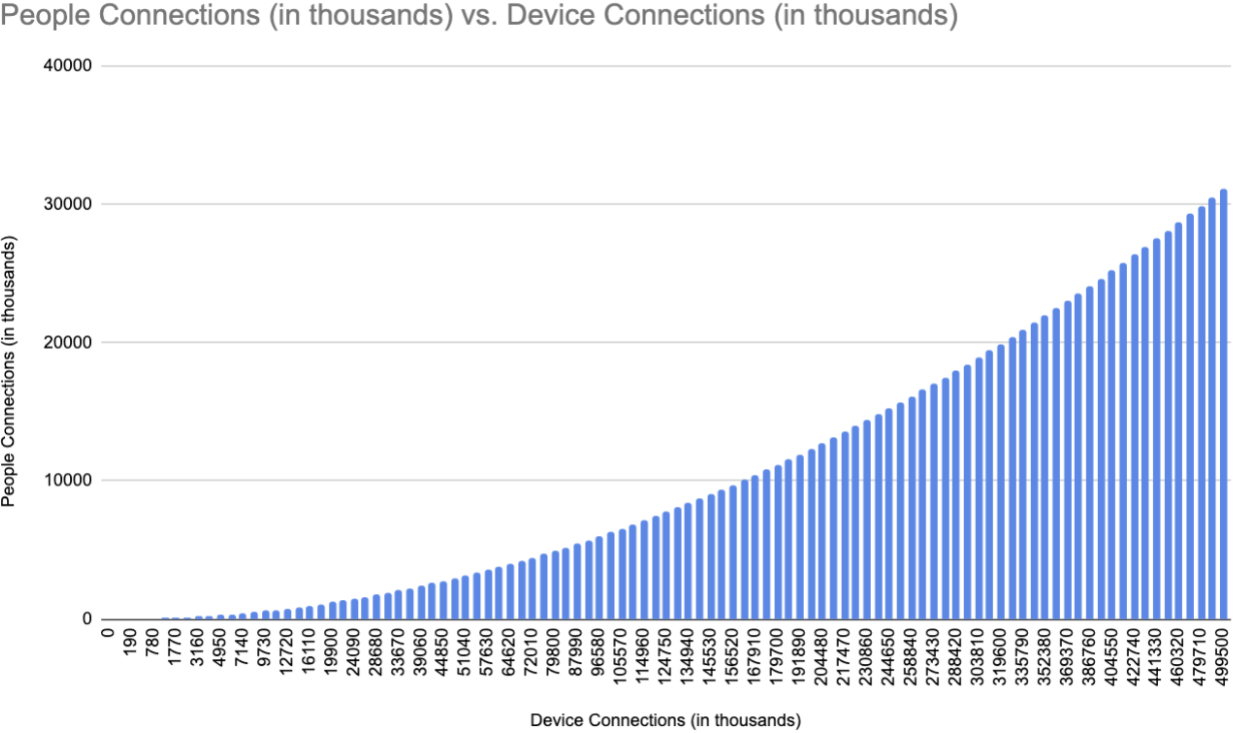
According to Metcalfe’s Law, with one million devices on the IoTeX Network there will be ~500 billion unique device-to-device connections. As the number of possible network connections grows exponentially, the number of useful network connections will also grow, paving the way for new win-win scenarios. The more devices are connected, the more utility the IoTeX Network will have! This all starts by achieving a critical mass of devices to begin exponentially scaling the connections/utility of the network.
A critical mass of devices will also unlock powerful human-to-machine and business-to-machine connections. We are nearing a future where humans/businesses will transact directly with machines, such as in the sharing economy to hail transportation or to command robo-workers along a supply chain. Although what is being connected differs, the same network effects and opportunities for new win-win scenarios exist. If one person has ten devices in their home, 45 new human-device and device-device connections will ultimately emerge. With every new human, device, or business onboarded, new network effects will be unleashed and the total size, utility, and value of IoTeX will grow.

With an exponentially growing number of connections, IoTeX users may choose which win-win opportunities they wish to pursue. This is what makes IoTeX an open network and why our vision is fundamentally different than the IoT of today, where users surrender autonomy to centralized tech giants that choke value for themselves. The current IoT is artificially constrained with tech giants inserting themselves in between every interaction. By onboarding the first one million IoTeX devices, we will not only exponentially grow the size of the network, but also instantiate an entirely new ecosystem of win-win, peer-to-peer interactions. The Internet of Trusted Things will unspool the connections away from centralized parties, spreading the IoTeX platform’s power and amplifying the total network value exponentially.
The Device-Infrastructure Innovation Cycle
The IoTeX Network consists of trusted devices and applications that are built on top of the IoTeX platform, which includes a variety of tools/resources including the blockchain itself to IoT-oriented middleware to dev tools/APIs to external service providers. Let’s think of the full range of IoTeX offerings as the infrastructure available to power devices. Our infrastructure is not built in isolation, rather it is built in parallel to align with the devices it seeks to support. For example, building Ucam required IoTeX to build new infrastructure in order to support our vision for a private security camera.
This virtuous cycle of new infrastructure empowering new devices, and new devices demanding new infrastructure is what we call the Device-Infrastructure Innovation Cycle.

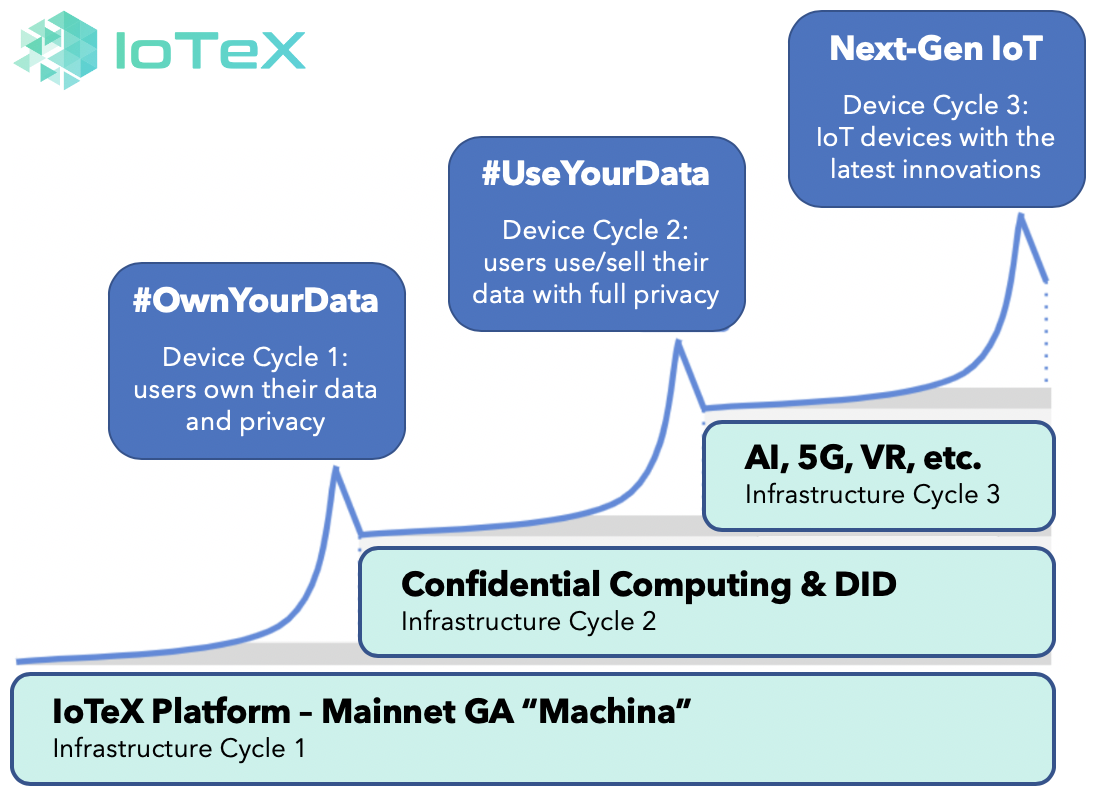
As shown in the graphic above, IoTeX has already undergone an intense infrastructure building phase. Over the past three years, the foundational infrastructure was built in the form of Mainnet GA (“Machina”), which is now powering the world’s first private smart devices that let users #OwnYourData. However, new infrastructure will need to be built in order to meet emerging requirements of next-gen devices. As other frontier technologies (e.g., AI, 5G, VR) mature and more service providers join the IoTeX Network, we can expect this cycle of device-infrastructure innovation to lead to an ever-evolving set of devices and infrastructure that ultimately feed off of each other.
The emergence of a critical mass of devices will jumpstart this device-infrastructure innovation cycle, bringing us closer to the Internet of Trusted Things. The first wave is cresting now with IoTeX Mainnet GA & DID serving as the backbone for #OwnYourData devices like UCam. The second wave is now underway with confidential computing and decentralized identity (DID), which will empower a new wave of devices that can compute in a privacy-preserving fashion. The following device-infrastructure waves will be multi-threaded, with new infrastructure enabling exciting AI-based use cases, data marketplaces, and much more. Throughout the coming years, IoTeX’s infrastructure will evolve to meet the needs of its human and machine users.
What Happens at One Million Devices
One million “Powered by IoTeX” devices is not the finish line; it is the starting line. The journey to one million will drive incredible momentum until device growth becomes self-sustaining — a flywheel of adoption attracting service providers, devices, and users to the ecosystem organically. Like compounding growth in a portfolio, progress that begins slow shocks with its ever increasing ability to expand, bloom, and change form. This is the magic of network effects and Metcalfe’s law, and it is also the magic of well-designed tokenomics. Bootstrapping is everything, and IoTeX is committed to aligning incentives, sharing the rewards of growth with our token holder community, and ultimately our community of devices and service providers.
We will see IoTeX Tokenomics come to life starting with Burn-Drop, which will #IGNITE in the near future. Remember that to be eligible for Burn-Drop, you will need to auto-stake your IOTX for ≥91 days! For more information on IoTeX Tokenomics, please see Part 1 on the utility of the IOTX coin, Part 2 on the DAO-based mechanics, and Part 3 on Burn-Drop and bootstrapping plan.
About IoTeX
Founded as an open source platform in 2017, IoTeX is building the Internet of Trusted Things, an open ecosystem where all “things” — humans, machines, businesses, and DApps — can interact with trust and privacy. Backed by a global team of 30+ top research scientists and engineers, IoTeX combines blockchain, secure hardware, and confidential computing to enable next-gen IoT devices, networks, and economies. IoTeX will empower the future decentralized economy by “connecting the physical world, block by block”.
Learn more: Website | Twitter | Telegram | Medium | Reddit
Source: https://medium.com/@iotex/iotex-times-a-million-scaling-the-internet-of-trusted-things-dc6055d2bf8b
Testadex Group News: IoTeX’s Pebble Tracker employs Nordic’s nRF9160 Si...
Testadex Group News: IoTeX’s Pebble Tracker employs Nordic’s nRF9160 Si...: Nordic Semiconductor today announces that Silicon Valley-based IoTeX, a technology company which combines blockchain and trusted hardware to...
IoTeX’s Pebble Tracker employs Nordic’s nRF9160 SiP long range wireless solution for global asset tracking
Nordic Semiconductor today announces that Silicon Valley-based IoTeX, a technology company which combines blockchain and trusted hardware to build privacy-oriented device IoT ecosystems, has selected Nordic’s nRF9160 low power System-in-Package (SiP) with integrated LTE-M/NB-IoT modem and GPS to provide the cellular IoT connectivity for its ‘Pebble Tracker’. The Pebble Tracker provides trusted location, environment, and motion tracking data for global asset tracking and industrial supply chain applications.
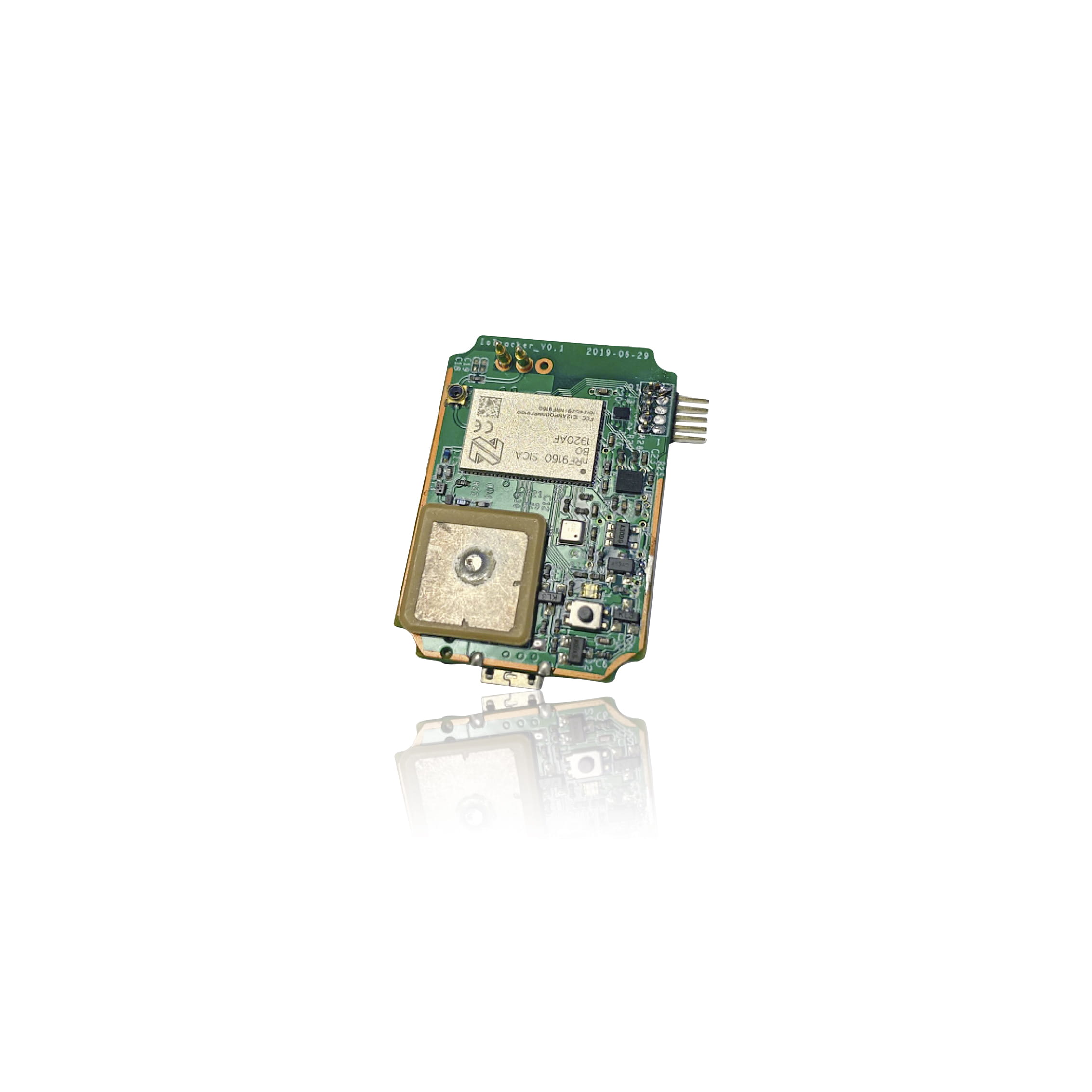
According to IoTeX the product meets the demand of applications that require strong data security, integrity protection, and multiparty trust across the entire supply chain. Existing asset tracking solutions lack critical security features, rendering them easily hackable and exposed to data corruption.
There are two versions of Pebble Tracker. The first targets blockchain and IoT developers while a second commercial version is designed for the asset tracking and industrial supply chain market.
By using secure solutions from semiconductor leaders such as Nordic, providers like IoTeX can build more trusted IoT applications
Raullen Chai, IoTeX
The product combines an environmental sensor (temperature, relative humidity, barometric pressure, altitude, and volatile organic compounds (VOCs)), a motion sensor (3-axis gyroscope, 3-axis accelerometer), and an ambient light sensor, with the nRF9160 SiP. The nRF9160 SiP enables cellular network connectivity and integrated GPS support in a single global version supporting precise, long range tracking of asset data using established cellular infrastructure.
To meet the most stringent security and privacy requirements demanded for “trusted” professional tracking applications, the nRF9160 SiP features Arm TrustZone™ for trusted execution and Arm CryptoCell 310 for application-layer security. In addition, the nRF9160 is the first secure hardware device to sync with the IoTeX blockchain, enabling large scale, decentralized asset tracking applications.
The nRF9160 SiP sends environmental and GPS data securely across mature global cellular networks to blockchain-based backend services and applications. There the data is used to determine if smart contracts have been satisfactorily fulfilled. For example, the trusted tracker data can reveal if, when, and where an asset has been mishandled—perhaps due to excessive vibration or temperature—and if damage has occurred, the blockchain contract can automatically penalize the courier company and compensate the customer.
The Pebble Tracker uses a 3.7V 750mAh Li-Poly battery, providing up to one week of battery life between recharge for a typical asset tracking application, thanks in part to the Nordic SiP’s low power characteristics. The nRF9160 SiP has been engineered to minimize power consumption with, for example, support for PSM and eDRX power saving modes.
The nRF9160 is a low power SiP, certified for global cellular IoT applications, comprising a dedicated application processor and memory, multimode LTE-M/NB-IoT modem with integrated RF front end (RFFE), GPS, and power management in a compact package. The 64 MHz Arm® Cortex®-M33 processor includes 1 MB Flash and 256 KB RAM, a range of analog and digital peripherals, automated power and clock management, Arm TrustZone, and Arm CryptoCell 310. The processor communicates with the LTE modem through a BSD secure sockets API and supports the application layer protocol (for example CoAP, MQTT or LWM2M) and the application itself. The nRF9160 SiP’s LTE modem supports both SIM and eSIM, offers 700 to 2200 MHz LTE band support, 23 dBm output power, and single pin 50 Ω antenna- and UICC-interfaces. The LTE stack layers L1-L3, IPv4/IPv6, TCP/UDP, TLS/DTLS are part of the modem firmware. Target applications for the nRF9160 SiP are asset tracking, smart city, smart agriculture, industrial, wearables, and medical among others.
The nRF9160 DK, a precertified single board development kit and the nRF Connect SDK, a software development kit which includes application layer protocols, application examples, and LTE modem firmware offered as precertified and precompiled downloads, ease product development and accelerate time-to-market. For the developer version of Pebble tracker, IoTeX has added blockchain-related APIs, enabling interaction with the IoTeX blockchain, to the SDK.
“We chose cellular IoT over other low power wireless area networks [LPWANs] because it supports long range communication, is derived from global cellular standards which ensure communication reliability and longer device operation lifetime, and takes advantage of existing cellular infrastructure, thereby allowing IoT solutions to enter the market quickly,” says Raullen Chai, IoTeX Co-founder.
“IoTeX’s vision for an Internet of Trusted Things requires a joint effort from the semiconductor industry and IoT solution providers,” adds Chai. “By using secure solutions from semiconductor leaders such as Nordic, providers like IoTeX can build more trusted IoT applications. This will help reorient the entire IoT ecosystem toward better user privacy control and security.
“Nordic is one of the key players for bringing low-power IoT solutions to the market, and provides complete embedded software development tools, well written documentation, and impressive technical support, which all contributed to our decision to use the nRF9160 SiP.”
“For the IoT to fulfil its potential, adopters will have to have absolute trust that the technology they are using is both secure and reliable,” says Geir Langeland, Nordic Semiconductor's Director of Sales & Marketing. “IoTeX’s Pebble Tracker delivers on both counts, supported by the in-built security features and reliability of both the nRF9160 SiP and cellular wireless technology.”
Burn-Drop Ignite — Kickstarting on July 31!
Earlier this month we announced Burn-Drop, a new tokenomics program where 1 Billion IOTX (10% of total supply) has been allocated to bootstrap the first 1 million “Powered by IoTeX” devices. For every new device that is registered to the IoTeX Network, a new Burn-Drop event will be triggered to drive continuous value to the overall network and individual stakeholders.
To prepare the community for Burn-Drop, we are excited to announce Ignite, a special campaign where long-term stakeholders can earn an extra 10% annualized returns throughout August! In this article, we introduce the Ignite campaign/timeline and explain the expected returns of Burn-Drop.


Ignite — the Precursor to Burn-Drop
Over the past month, IoTeX has developed new websites, smart contracts, and tools to power Burn-Drop for years to come. Before Burn-Drop is officially activated, we are hosting a special Ignite campaign starting July 31 to familiarize the IoTeX community with our new suite of Burn-Drop technology. Ignite will run throughout August for approximately four weeks.
During Ignite, stakeholders can earn an extra 10% annualized returns on all IOTX that is auto-staked for ≥91 days, as well as a limited edition Ignite NFT. This is in addition to the ~8% annualized rewards you already receive by staking/voting for Delegates. This means by participating in Ignite, you can earn ~18% total annualized returns throughout August!

During Ignite, IOTX will be distributed on a daily basis via smart contracts to all eligible stakeholders. The IOTX will be added directly to each eligible bucket, which allows for daily compounding of your principal and interest. Note: a discretional cap on the total IOTX distributed throughout Ignite may be applied by the IoTeX Foundation.
So what are you waiting for? Set your buckets to auto-stake for ≥91 days and get ready for Ignite! We look forward to kicking off Ignite on July 31 and hearing your feedback.
Burn-Drop Economics: Let’s Break It Down
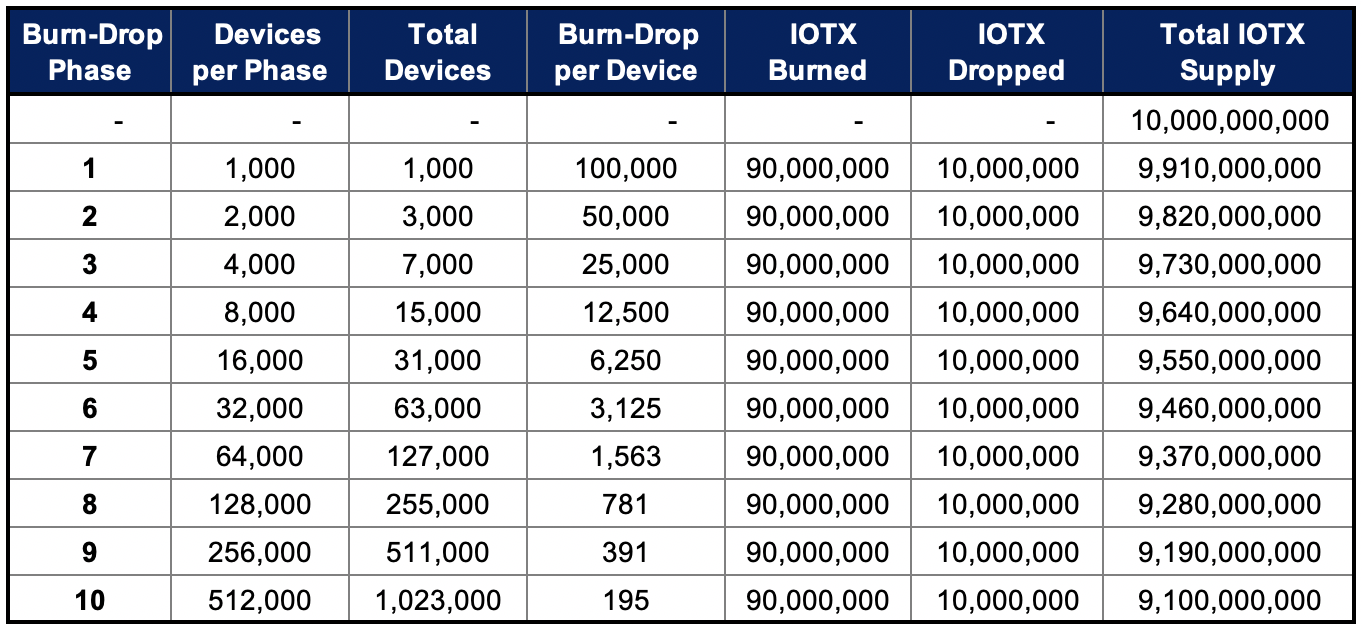
After Ignite concludes, Burn-Drop will be officially activated. As the name implies, Burn-Drop consists of two components — Burn & Drop. Of the total 1 Billion IOTX reserved for Burn-Drop, 90% (900M IOTX) will be burned and taken out of circulation, while 10% (100M IOTX) will be dropped to the wallets of long-term stakers. The Burn-Drop schedule consists of ten phases and is summarized in the table below.

Expected Burn-Drop Returns for Long-Term Stakers
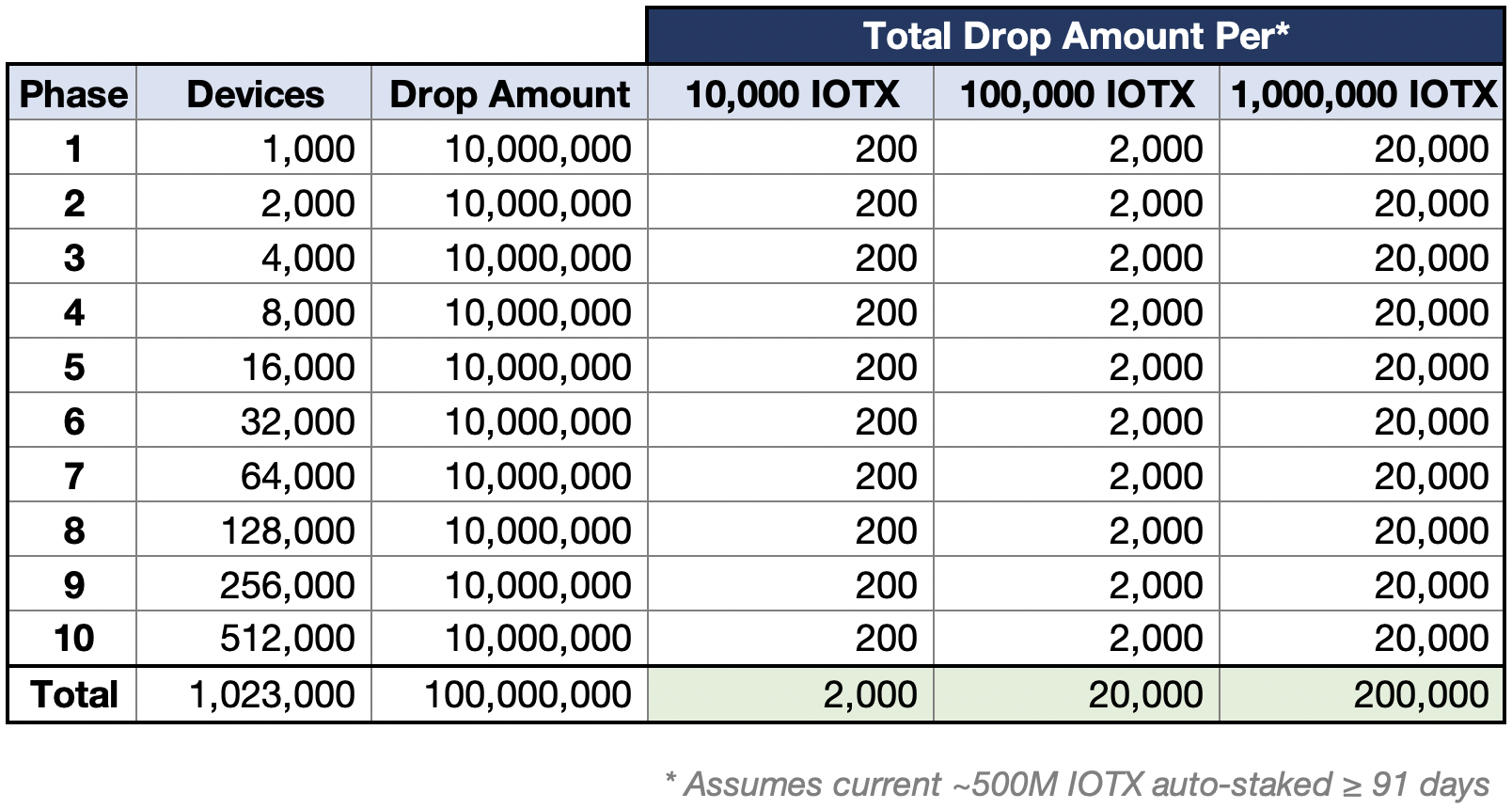
In addition to the ~8% annualized rewards you already receive from staking/voting for Delegates, you can earn up to 20% extra returns on your staked IOTX throughout the Burn-Drop program. All buckets that are auto-staked for ≥91 days are eligible for Burn-Drop — the more IOTX you stake long-term, the more rewards you will receive!
Throughout the Burn-Drop program, a total of 100 Million IOTX will be “dropped” to the wallets of long-term stakers. Every new device that is registered to the IoTeX Network will trigger a new Burn-Drop event in a cumulative fashion. We provide some guidance on calculating your expected Burn-Drop returns below.
Returns = [(Your Eligible IOTX)/(Total Eligible IOTX)] * 100M IOTX

More exciting details about Burn-Drop and the official activation date will be announced throughout the Ignite program. For more information, please see our previous post on Burn-Drop.
What’s Next?
Ignite will officially kick off on Friday, July 31, and will last for approximately four weeks as we fine-tune our new suite of Burn-Drop technology. We will be debuting exciting tools across front-end (e.g., website, dashboards) and back-end (e.g., smart contracts, repos) in the coming weeks.
Burn-Drop & Ignite will jumpstart IoTeX’s journey to 1 Million devices, as well as unleash incredible value to the overall network and individual stakeholders. With the powerful network effects and growth-oriented tokenomics that Burn-Drop will provide, IoTeX will make significant strides towards our vision for the Internet of Trusted Things. Join us!
About IoTeX
Founded as an open-source platform in 2017, IoTeX is building the Internet of Trusted Things, an open ecosystem where all “things” — humans, machines, businesses, and DApps — can interact with trust and privacy. Backed by a global team of 30+ top research scientists and engineers, IoTeX combines blockchain, secure hardware, and confidential computing to enable next-gen IoT devices, networks, and economies. IoTeX will empower the future decentralized economy by “connecting the physical world, block by block”.
Subscribe to:
Posts (Atom)
How to Let Your Partner Know You're Not in the Mood without hurting
For couples, emotional connection and sexual intimacy are dynamically related, so difficulties in one area often destabilize the other are...

-
For couples, emotional connection and sexual intimacy are dynamically related, so difficulties in one area often destabilize the other are...
-
Greetings our dear supporters! We are back with our Monthly Project Update for October 2020. Now that Ucam is listed on Amazon , we are ...
-
IoTeX and IOTA are two cryptocurrencies that are looking to connect IoT and cryptocurrency to improve efficiency and security. All data is a...

